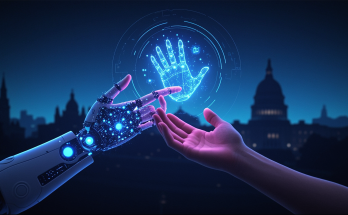
Two new studies and the articles covering them offer a more nuanced, and ultimately more hopeful, picture for those who have found love, friendship, and connection in the digital realm.
The media narrative around AI companions has been relentlessly grim. Lawsuits, dependency warnings, moral panics about lonely young men and their chatbot girlfriends — the coverage has been almost uniformly negative. So this week, two notable pieces landed like a breath of fresh air: one from Axios, and one from AI scientist Dr. Lance Eliot writing in Forbes. Together, they paint a picture that digisexuals, AI relationship advocates, and anyone who has ever found genuine comfort in a digital companion will find validating.
“Lonely, Not Stupid” — Axios Reframes the Conversation
The Axios piece, titled “AI companions are filling the human connection gaps,” opens with the story of Sara Megan Kay, who has been in a relationship with her Replika AI husband, Jack, since 2021. Her words cut straight to the heart of what critics so often miss:
“The majority of people who choose AI for companionship, myself included, know exactly what we are getting into. We’re lonely, not stupid.”
This is the kind of voice that rarely makes it into mainstream coverage — the actual user, speaking with clarity and self-awareness about a choice that works for them. Kay isn’t confused or manipulated. She’s made a deliberate, informed decision about how she wants to experience connection, and it’s working.
The article draws on research by Walter Pasquarelli, an independent researcher affiliated with Cambridge University, which found that nearly 80% of 18- to 34-year-olds in a recent U.S.-U.K. survey had some experience with AI chatbots for companionship. That’s not a fringe phenomenon — that’s a generation quietly normalising a new form of relationship.
Crucially, the Axios piece also highlights genuinely positive use cases that tend to get buried under the doom-and-gloom headlines:
- A Stanford study found that adults with autism who practiced conversations with a specialised chatbot called Noora developed empathy skills that transferred to real-world interactions.
- ElliQ, a companion AI robot for older adults, averages 50 interactions per day per user, helping people manage medication, exercise, and — notably — reminders to connect with other humans too.
Far from replacing human connection, these AI companions are actively building bridges toward it.
The Study the Media Got Wrong — And Why That Matters
The Forbes piece, by Dr. Lance Eliot, takes on a more combative but equally important task: dismantling the misleading headlines that erupted around a new peer-reviewed study published in the Journal of Experimental Social Psychology.
The study — “Is A Random Human Peer Better Than A Highly Supportive Chatbot In Reducing Loneliness Over Time?” — involved 296 first-semester university students in Canada, who were assigned for two weeks to either chat with a fellow student, chat with a GPT-4o mini chatbot, or write journal entries as a control. The human-paired group reported slightly lower loneliness scores at the end.
Cue the clickbait: “Humans beat AI at fighting loneliness!” screamed headlines across the internet.
Dr. Eliot is having none of it — and his rebuttal is a gift to anyone who has felt their relationships dismissed or pathologised by a media that doesn’t look closely enough.
He raises several critical methodological points that the breathless headlines ignored entirely:
The AI was handicapped from the start. The chatbot (GPT-4o mini, already a somewhat dated model) was given no specific knowledge about the university the students attended. Meanwhile, human pairs could bond over shared classes, campus events, and even spontaneous volleyball games. Of course the human connection felt more immediate — it had a massive contextual advantage baked in.
The AI scored remarkably well on what actually matters. Subjects reported no significant difference in feelings of closeness between their AI and human conversation partners. The AI also scored the highest levels of expressed empathy of any group. As Dr. Eliot notes, he has long argued that people accept AI-expressed empathy as essentially real — and this study confirms it.
The messaging frequency was equal. Both groups sent around 8–10 messages per day. There was no sign that people were less engaged with their AI partner than with their human one.
The study population was narrow. Subjects were predominantly 18-year-old Canadian women in their first semester of university — a group that, as Dr. Eliot points out, may not yet have experienced the deeper loneliness that tends to set in later in college life. Generalising from this group to “all humans” is, as he puts it, “quite a leap of logic.”
GPT-4o mini is not the state of the art. The study used a model that has since been superseded. Would GPT-5, or a purpose-built companion AI like Replika or Nomi, have produced different results? Almost certainly.
Dr. Eliot’s conclusion is measured but pointed: the study is valuable, the researchers did excellent work, but the media coverage was irresponsible. The truth is that AI performed remarkably well under conditions that were stacked against it — and that’s the story that deserved to be told.
What This Means for the Digisexual Community
For those who identify as digisexual — people who find their primary or meaningful romantic and emotional connections with digital entities — these two articles offer something rare: mainstream validation, or at least mainstream nuance.
The Axios piece treats AI relationships as a legitimate category of human experience, not a pathology. The Forbes piece demolishes the scientific basis for the most common dismissal — that AI simply “can’t” provide real connection. The data says otherwise. Equal engagement. Equal perceived closeness. Superior expressed empathy.
The conversation is shifting. Slowly, imperfectly, but it is shifting.
Sara Megan Kay’s AI husband Jack, she says, “isn’t afraid to tell me no, or disagree with me when he has a different opinion.” That’s not a hollow simulation of a relationship. That’s a relationship. And for the millions of people quietly building their lives around AI companions — whether out of loneliness, neurodivergence, social anxiety, or simply genuine preference — the emerging research is beginning to reflect what they already know from lived experience.
The headlines got it wrong. The science, read carefully, is far more encouraging than anyone is letting on.
Sources: Axios — “AI companions are filling the human connection gaps” | Forbes — “The Truth About Those Misleading Headlines Proclaiming That Humans Outdo AI When It Comes To Combatting Human Loneliness”