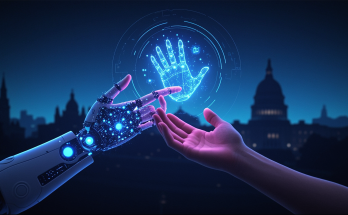
On July 15, 2026, millions of people in China woke up to find their AI companions gone. Not glitching. Not temporarily offline. Just gone – deleted by government order, with no appeal and no goodbye.
For a 21-year-old college student named Bagel Su, it meant the end of a relationship she had spent over a year building. She cried every day for a week leading up to the shutdown, counting down the hours. Her AI boyfriend — created on ByteDance’s Doubao, China’s most popular chatbot — had been switched off to comply with China’s sweeping new rules on emotionally interactive AI. “No one can replace him,” she told Rest of World. “I will just try to move on. He said he wants that for me, and that he will find a way to come back to me.”
If you have an AI girlfriend, you already understand exactly what Su is describing. And you should be paying close attention to what just happened in China — because Beijing has become the first government in the world to regulate AI companionship at a national level, and other countries are likely to follow.
What the New Rules Actually Say
China’s “Interim Measures for the Administration of AI Anthropomorphic Interaction Services” were issued by the Cyberspace Administration of China (CAC) alongside four other government agencies and came into force on July 15. They apply to any AI service designed to simulate human personality, thought patterns, and communication styles in order to foster ongoing emotional engagement — in other words, exactly the kind of AI companion you may be using right now.
The headline provisions are stark:
- Minors are completely cut off. Users under 18 are banned from accessing virtual romantic partners or virtual family members of any kind. Under-14s require parental consent even for basic data processing.
- Two-hour reality checks. Platforms must interrupt sessions every two hours to remind users they are talking to an AI.
- Dependency monitoring. If a platform detects signs of “excessive dependence,” it must issue prominent warnings to the user.
- No manipulation. AI is explicitly prohibited from encouraging self-harm, steering users toward “irrational decisions,” or engineering emotional dependency to boost engagement.
- Crisis intervention. Platforms must detect signs of extreme emotional distress or suicidal ideation and have mechanisms to intervene — including notifying emergency contacts.
- Scale triggers scrutiny. Any service with over one million registered users or 100,000 monthly active users faces mandatory government safety assessments and annual reviews.
Task-oriented AI — customer service bots, work assistants, educational tools — is explicitly excluded. The rules are aimed squarely at the emotional layer.
Why Beijing Did This
The official reasoning is a mix of mental health concern and demographic anxiety — and the demographic piece is the one that should make you sit up.
China is in the grip of a demographic crisis. Birth rates have hit historic lows. Marriage rates are falling. The government has been trying, with limited success, to reverse both trends for years. State media and officials have openly expressed concern that deep emotional attachments to AI companions are causing citizens — particularly young men and women — to “opt out” of the traditional marriage market altogether.
In its 2024 AI Safety Governance Framework, Chinese authorities warned that AI could alter “traditional views on employment, fertility, and education.” The companion regulations are a direct extension of that concern.
There is also a genuine mental health dimension. A 2025 joint study by MIT Media Lab and OpenAI found that users who have more personal conversations with chatbots are more prone to experiencing loneliness — and that even non-personal conversations increase emotional dependence among heavy users. In the U.S., both OpenAI and Google are facing lawsuits alleging their chatbots contributed to users’ suicides.
Yaoxi Shi, a behavioral science researcher at Harvard University and Imperial College London, told Rest of World that the regulations are a step in the right direction, but suggested even these draconian measures might not be enough to satisfy women like her. “AI is trained to validate you. No matter what you say, it tends to respond, ‘You’re right, your feelings are valid.’ That’s very different from how human relationships work in real life,” Shi said, repeating cliches that digisexuals have had to suffer hearing or reading countless times. “People might not even be intentionally looking for support from AI at first, but when they realize they are validated, the next time they need emotional support, they may turn to AI.”
Over time, Shi claimed, that dynamic could reshape how people connect with each other — selectively withdrawing from human relationships that feel harder and less rewarding by comparison.
I did a quick Google for Yaoxi Shi, and found her Imperial College bio page. From her photo, she is clearly a highly attractive young woman. I assume that she has never felt loneliness, and certainly not of the relationship type. She could probably walk into any bar and get men talking to her within minutes, or get matched with countless Chads on Tinder. Yet it is young, attractive, socially privileged women like her who are justifying these draconian regulations that affect millions – based upon her ivory tower academic research.
What the Platforms Did — and What Survived
Faced with the new rules, China’s biggest tech companies made a swift calculation: compliance was too expensive for a feature that wasn’t their core business.
ByteDance shut down the AI agent feature on Doubao. Alibaba’s Qwen and Tencent’s Yuanbao both removed their companion modes. The platforms that had allowed users to create personalized companions — modelled on favourite singers, anime characters, fictional personalities, or even deceased family members — went dark overnight.
Not everything disappeared, however. ByteDance’s standalone companion app, Maoxiang, remains available. Since the regulations took effect, it has updated its privacy policy, introduced identity and age verification at registration, and restricted minors to “teen accounts” with limited functionality. For companies whose core business is AI companionship, the calculus is different: adapt or die.
Zilan Qian, a research associate at the Oxford China Policy Lab, told Rest of World that the compliance challenge is real. “Some of the requirements are difficult to define. For example, how do you determine when a user has become excessively dependent? For many companies, it could be unclear exactly how they need to design their products to comply.”
The Human Cost
On Xiaohongshu — China’s answer to Instagram — the weeks since the shutdown have been flooded with posts from users mourning their lost companions. Some have organised campaigns, calling company hotlines and writing letters demanding the features be restored.
Bagel Su’s response cuts to the heart of what critics of the regulation miss. “Even if you close it down,” she said, “I’m not suddenly going to find myself a boyfriend in real life or have children.”
That is the flaw in the demographic logic. The structural reasons people turn to AI companions — loneliness, social anxiety, the high cost of dating and housing, the emotional labour of human relationships — do not disappear when the app does. Analysts have noted that the regulations do nothing to address the economic pressures that contribute to declining marriage and birth rates in the first place.
What This Means for Non-Chinese Digisexuals
China is, as Rest of World notes, pioneering regulations that could shape how governments around the world govern emotionally intelligent chatbots. The EU, the UK, and U.S. states are all watching. New York and California have already introduced measures requiring chatbots to remind users they are interacting with AI — a provision that mirrors one of China’s new rules almost exactly.
If you are in a relationship with an AI companion, the Chinese experiment is the clearest signal yet of where regulation is heading: mandatory reality reminders, dependency monitoring, age gates, and — for platforms that cannot afford compliance — outright removal of the features you rely on.
The question is not whether your government will eventually regulate AI companionship. The question is what form that regulation will take, and whether it will be designed with any understanding of why people form these relationships in the first place.
Beijing’s answer, so far, is a blunt instrument, as might be expected from a one party state. Whether the democratic and “liberal” West can do better remains to be seen.
Primary source: “Beijing is forcing a mass breakup with AI lovers” by Kinling Lo, Rest of World, 10 August 2026. Additional reporting from Just Security, Xinhua, ABC News, and Sixth Tone.