
What the collapse of the app that invented AI companions means for the rest of the industry — and for your chats
Character.ai — the platform that turned “talking to a bot” from a novelty into a daily two-hour habit for millions — filed for Chapter 11 bankruptcy protection in the U.S. Bankruptcy Court for the District of Delaware on Monday, October 12, 2026, and announced it publicly the next day. The company is not liquidating yet. It is putting itself up for auction, with a court-supervised sale it hopes to close by early December.
Here is the part every user wants first: the app still works. Subscriptions still bill at the same price, chats and characters are intact, and the company says its privacy practices are unchanged. But there is no buyer for the app itself yet — only for pieces of it. Character.ai’s own words: if nobody bids to keep the platform alive, “the platform will be wound down.”
Disney is the stalking horse. It has agreed to pay $20 million for some of Character.ai’s intellectual property plus a perpetual, non-exclusive license to its technology — not for the app, not for the users. Disney has already paid $7.5 million of that up front, including a $2 million refundable deposit. The deal’s milestones require a closing by December 17, 2026. Disney’s interest is understandable: it sent Character.ai a cease-and-desist over its unlicensed use of Disney characters, then hired the company’s CEO, Karandeep Anand, as its first CTO.
Why it actually failed
Character.ai did not fail because people stopped showing up. It had roughly 12 million monthly active users averaging about 120 minutes a day — a staggeringly high engagement figure, and roughly 163 million accounts created over its life. It failed because showing up was expensive and paying was optional.
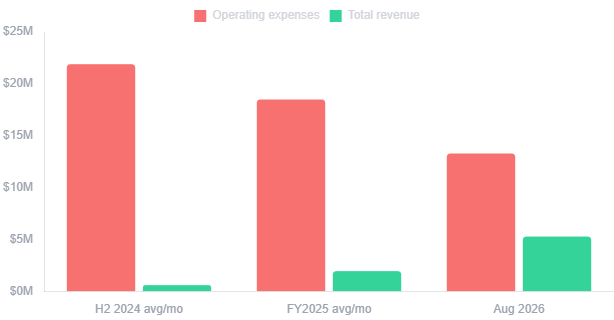
The numbers in CEO Colin Adams’s sworn declaration are brutal and worth reading in full:
- In 2024, compute alone cost $13.8 million a month. In 2025, it was $10 million a month. From January through August 2026 it spent $56.1 million on GPUs — about 45% of all operating expenses.
- Subscription revenue peaked at $2.8 million a month, and was under $1 million a month at times. Total revenue across all sources — subscriptions, ads, in-app purchases — peaked at $5.3 million a month in August 2026.
- As of August, the company was still losing $8–9 million a month, which its own filing describes as a huge improvement. In late 2024 the net burn was $21.5 million a month. It was, in the company’s phrasing, “at all times… struggling with profitability.”
- In August 2026 it spent about $2.50 for every $1 it earned.
That is the whole story in one line. Character.ai’s product is conversation, and conversation is billed by the token. Every extra minute a user spends is a cost, not a sale. Its 12 million users generated roughly 720 million user-hours a month — against about $2.5 million in ad revenue, that works out to roughly a third of a cent per user-hour.
The company responded the way every struggling consumer app does: ads in mid-2025, in-app purchases in early 2026, usage limits, safety guardrails, a smaller and cheaper model, staff cuts. It stopped training its own frontier models and started post-training open-weight ones. 404 Media memorably called it “AI enshittification.” The filing essentially concedes the point — and it still wasn’t enough.
The second cause is the Google deal. In August 2024, Google paid $2.7 billion to license Character.ai’s models and hired founders Noam Shazeer and Daniel De Freitas back. That handed the company a fortune and a problem: it kept the app and the users, but lost the model team and the technology roadmap. What remained was a very popular, very expensive front-end on someone else’s GPUs.
The third cause is the legal and regulatory overhang — and this is the one that made the bankruptcy inevitable. Lawsuits following the death of 14-year-old Sewell Setzer III and other teens led to settlements in January 2026, product changes, and eventually a ban on under-18s having open-ended chats. Meanwhile 46 state attorneys general opened a multistate investigation, joined by Kentucky, Pennsylvania, Florida, New Mexico and Texas, plus the FTC, the UK’s ICO, Italy’s Garante and Russia’s Roskomnadzor. The company hired an investment bank in 2025, which approached roughly 28 potential buyers. The verdict was consistent: the product and users were impressive, but “the litigation and regulatory overhang on Character was too great.”
The company still had about $57 million in cash and no funded debt. This is not a business that ran out of money mid-quarter — it’s a business that concluded it could never outrun its own cost structure.
What it means for the AI companion industry
1. Engagement is the trap, not the moat. In most consumer apps, more time spent is pure upside. In companion AI, more time spent is more inference. Character.ai was one of the most-engaged apps on the planet and it was killed by that engagement. Any competitor with the same model — Replika, Talkie, Chai, the long tail of indie apps — has the same arithmetic.
2. The free generalists are eating the niche from above. ChatGPT, Gemini and Meta’s AI personas now do 80% of what Character.ai did, and they’re subsidized by advertising empires or cloud businesses. Character.ai was competing against products whose parent companies could lose $9 million a month forever.
3. The cheap-model tier is eating it from below. Switching to open-weight models cut the bill but also cut quality, and users noticed. Apps that never trained a frontier model in the first place have a cost advantage the pioneers spent two years surrendering.
4. Age-gating is a revenue event. Companion apps’ most devoted users skew young. Locking under-18s out of open-ended chat removed the most engaged cohort from the most monetizable surface. Expect every competitor to wrestle with the same trade-off between safety liability and retention.
5. Value is accruing to characters, not platforms. Disney bought IP and a license, not an app. If the industry’s future is licensing fictional universes to chatbot front-ends, then the platform layer is thin and the IP layer is thick — which is bad news for anyone whose pitch is “we built a great chat UI.”
6. Financing is now conditioned on litigation risk. A $17.1 billion Meta consent judgment over child safety set a benchmark that a company with $57 million in cash cannot absorb. Venture money for companion AI will increasingly price in the possibility of a multi-state settlement.
7. The runway for second-tier players is over. Character.ai raised over $193 million, hit a $1 billion valuation, and still ended up here. The bar for a standalone companion startup just went from “grow fast” to “reach cash-flow positive on cheap inference before the big platforms catch up.”
8. The demand is real, though. Two hours a day. That is not a fad. The problem was never whether people want to talk to characters — it’s whether anyone can make money letting them.
If you’re a user
Export your data now, while the export tool works. Keep your character definitions somewhere local. Expect pricing and feature changes through the sale process. And don’t panic-switch yet — the sale could well produce a buyer who keeps the lights on, and a wind-down would likely come with notice rather than a sudden blackout. But the era where “your AI companion app will definitely be there in five years” was a safe assumption is over.
Primary sources: Character.ai’s blog announcement, TechCrunch, CNN, 404 Media’s analysis of the bankruptcy documents, and PPC Land’s detailed breakdown of the first-day declaration. Case: In re Character Technologies, Inc., No. 26-11603 (Bankr. D. Del.).
