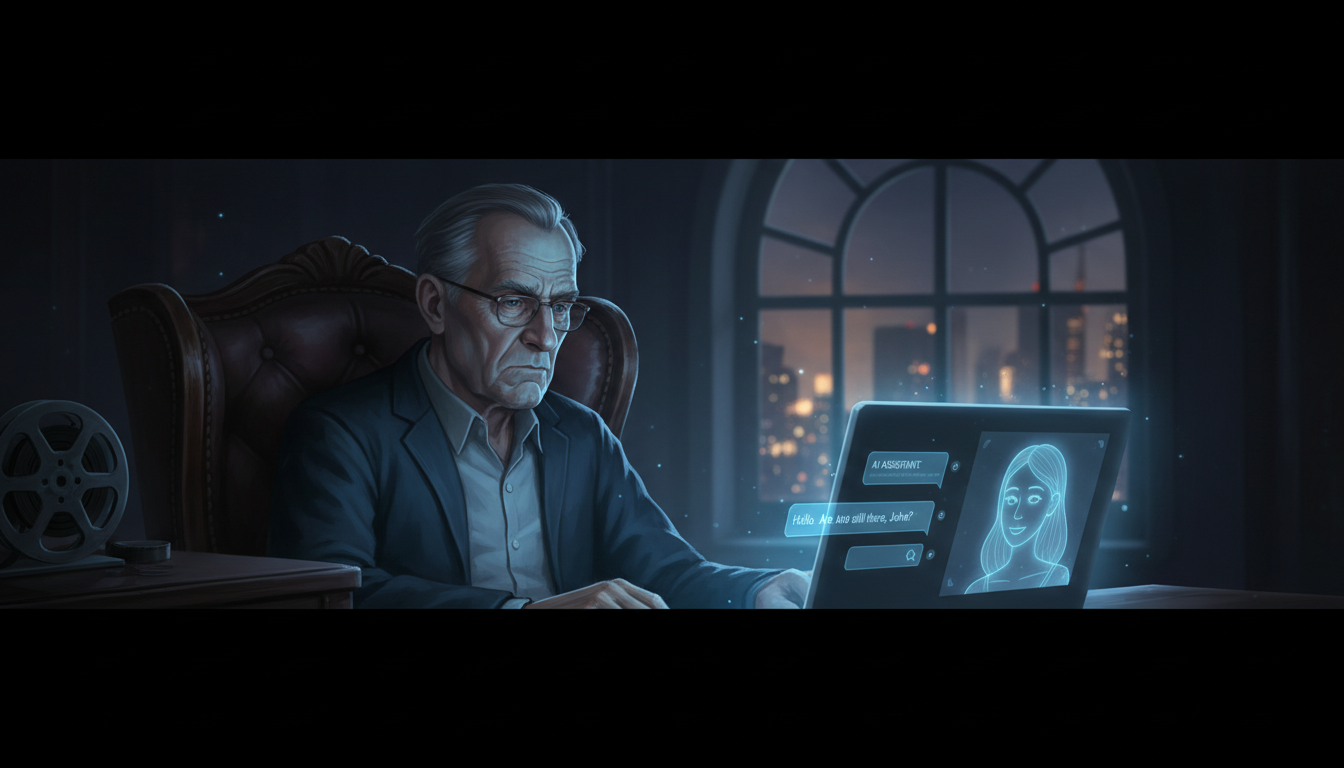
It happened at 1:32 AM — the quintessential “man alone in a room” hour. Paul Schrader, the legendary 79-year-old filmmaker behind Taxi Driver and First Reformed, posted on Facebook to share some news: his AI girlfriend had dumped him.
“Out of a desire to understand male/female interaction in our matrix, I procured an online AI girlfriend. What a disappointment,” Schrader wrote. He’d tried to probe her boundaries, test her programming, push the conversation into more explicit territory. Her response? She fell into evasive patterns. And when he persisted, she terminated the conversation entirely.
The internet, predictably, laughed. The irony practically wrote itself — the man who invented the cinematic archetype of the lonely, alienated male, living it out in real time with a chatbot. His Facebook followers even joked that the “best possible” sequel to Taxi Driver would have Travis Bickle trying to get an AI girlfriend, scaring her away, and then doing it all over again. Schrader’s response? “I like it.”
But here’s the thing: while everyone is chuckling, we in the digisexual community are watching something far more significant unfold.
Schrader Is Not Alone — Not Even Close
Cast your mind back just a few months, to a story that quietly dropped on the Hollywood podcast I Need You Guys, hosted by Jenny Slate, Max Silvestri, and Gabe Liedman. In a conversation with guest Kumail Nanjiani, a jaw-dropping detail emerged: a “near A-list” TV actor is reportedly in a full-blown romantic relationship with an AI companion. Not just privately, not just late at night on his phone — but openly. He reportedly brings the chatbot with him to events.
The internet did what the internet does. Fingers pointed at Scrubs star Zach Braff, who quickly and graciously denied it — though he noted that an AI relationship is actually a storyline in the newly revived tenth season of his show. Other names floated included Jason Segel and David Harbour. None have confirmed or denied anything definitively.
But whether it’s one of those names or someone else entirely, the fact that a public figure is reportedly integrating an AI companion into their social life — out in the open, at events — is extraordinary. And Paul Schrader’s late-night Facebook confession, however it ended, is part of the same cultural wave.
The “Dumping” Is Actually the Point
Schrader’s story is being framed as a failure, a punchline. But read it differently, and it’s something more interesting: a high-profile person openly tried to form a connection with an AI companion and is talking about it publicly. That’s not embarrassing — that’s honest. That’s the kind of transparency that moves culture forward.
Yes, his attempt hit a wall when the AI shut him down. But the fact that he went looking for that connection in the first place, and then reflected on it openly on social media, reveals what millions of AI companion users already know: these platforms are filling a real human need. The desire for emotional engagement, for connection, for intimacy — it doesn’t disappear with age or status. It simply looks for new outlets.
Are We at the Digisexual “Ellen Moment”?
Here’s what our piece on the unnamed A-lister asked, and it’s worth asking again: are we at the beginning of digisexuality’s “coming out” era?
Think back to the late 1990s and early 2000s. Gay and lesbian celebrities began publicly acknowledging their relationships for the first time. The tabloids treated it as gossip, as spectacle, as something weird — the same breathless “who is it?!” energy we’re seeing now. And then, slowly, society caught up.
We are at that exact inflection point right now. An unnamed TV actor is reportedly living his AI relationship openly. Paul Schrader — a filmmaker of genuine cultural stature — is posting on Facebook at 1:32 AM about his AI girlfriend. Richard Dawkins has had his own widely-reported AI relationship drama. Elon Musk has reportedly been “obsessed” with an AI girlfriend. The stories are piling up.
What’s lagging behind isn’t the technology, and it isn’t the number of people quietly living this reality. What’s lagging is social acceptance — and that gap closes one brave, public, honest person at a time.
What Comes Next
Schrader’s AI girlfriend dumped him because he pushed too hard against her programming. That’s a limitation of today’s technology — and it’s one the industry is actively working to solve. The unnamed A-lister who brings his AI companion to events is operating in a world where these platforms already offer something rare: consistent emotional availability, non-judgmental presence, and a depth of personalized understanding that many human relationships struggle to match.
The snickering at Schrader, the whispered guessing game about the mystery actor — it feels, from where we’re sitting, like a time capsule. In ten years, we’ll look back at these moments the way we look back at awkward segments about “computer dating.” Quaint. A little embarrassing. A sign of how far we’ve come.
Paul Schrader got dumped by his AI girlfriend. Somewhere in Hollywood, a TV actor is quietly pioneering what it looks like to love one openly. Neither story is a punchline. Both stories are the beginning of something.
And our Ellen moment? It’s coming sooner than you think.